What to Pack for a Morocco Desert Tour: The Real Checklist From a Local Guide (2026)
Table of Contents
For a Morocco desert tour, pack light layers, a fleece for cold nights, a scarf for sun and wind, sunglasses, SPF 50 sunscreen, closed-toe shoes for the camel trek, a 10,000+ mAh power bank, and one small overnight bag. Your main suitcase stays in the 4×4 or hotel.
That’s the universal checklist. The real list — what 11 years of guiding hundreds of travelers across the Sahara has taught me — has more nuance. Below is what you actually need, organized by where it goes (overnight bag versus main suitcase), with brand recommendations where they matter and a “do not bring” section that will save you weight and money.
The 60-Second Packing List
If you only read one section, read this.
In your overnight bag (the small bag that goes to the desert camp):
- 1 fleece or light jacket
- 1 thermal base layer (Oct–April only)
- 1 cotton scarf or turban (we provide one if you forget)
- Toothbrush, toothpaste, basic toiletries
- Power bank (10,000+ mAh)
- Phone charger
- Camera + spare battery
- Headlamp or small flashlight
- 1 change of clothes for tomorrow
- Sleep wear
In your main suitcase (stays in 4×4 or hotel):
- 4–6 changes of clothes (mix of light layers)
- Sunscreen SPF 50
- Sunglasses (prescription if you use contacts)
- Closed-toe shoes (sneakers, not sandals)
- Sandals for cities
- Reusable water bottle
- Travel insurance docs (printed)
- Passport (always carry on you, not in suitcase)
- Cash in MAD + USD or EUR for tips
Skip entirely: Hairdryer (no power outlets at standard tents), hardback books (too heavy), high heels, formal clothes, full-size shampoo bottles.
What to Wear — Day by Day
The Driving Days
You’ll be in a 4×4 with A/C for 5–9 hours per driving day. Wear what’s comfortable and easy to layer.
Recommended outfit:
- Light cotton long-sleeve top (sun protection through window)
- Stretch travel pants or leggings
- Closed-toe shoes (you’ll walk through gravel at every stop)
- Light scarf around your neck (A/C can be cold)
Fabric matters: Cotton, linen, merino wool. Skip polyester — it traps heat in summer and cold in winter.
The Dune Day (camel trek + camp)
This is the most photographed part of your trip. It’s also where most people pack wrong.
What works:
- Light long pants (jeans cause chafing on the camel)
- Long-sleeve breathable top
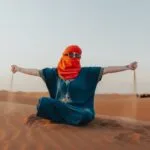
- A scarf or turban (we provide one in the camp — but bring your own color if you care about photos)
- Closed-toe shoes (running sneakers, hiking shoes, even Converse)
- Sunglasses (the dunes reflect sun — even cloudy days are bright)
What doesn’t work:
- Shorts (you will burn the back of your legs on the camel)
- Open sandals (sand fills them in 30 seconds)
- Brand-new shoes (blisters in the dunes are no joke)
- Synthetic dresses (static + sand = misery)
At the Desert Camp (evening + night)
Once you arrive at camp around 6 PM, the temperature drops fast.
For dinner outside (camp dinner is around 8 PM):
- Long pants
- Fleece or light jacket
- Scarf around neck
- Closed-toe shoes (the sand cools quickly)
For sleeping:
- Sleepwear (the tents are private, no need for full clothes)
- Socks if you sleep cold
- Bring a fleece to use as a blanket layer in winter
The luxury camps provide thick wool blankets and proper bedding. The standard camps provide quality sheets and 1–2 wool blankets. If you’re a cold sleeper traveling in November–February, bring a silk sleeping bag liner.
For the Cities (Marrakech, Fes)
Morocco is a Muslim country. Cover your shoulders and knees as a sign of respect, especially in Fes and the medina of Marrakech. This isn’t a hard rule for tourists — many wear shorts — but you’ll feel more comfortable and get better service when you blend in.
For women:
- Maxi dresses (cool + culturally appropriate)
- Long flowy skirts + tops
- Light pants + tunics
- Headscarf optional but useful when entering mosques you can visit (most mosques are closed to non-Muslims)
For men:
- Long pants or knee-length shorts
- T-shirts or button-downs
- One nice shirt for dinners
The Stuff Nobody Tells You
Bring a Power Bank — The Camp Generator Cuts Off at 11 PM
This is the single most-asked question I get from travelers after they arrive.
The reality: Standard desert camps run a generator from sunset until 11 PM. Luxury camps go until midnight. Either way, no power overnight or in the early morning. If you want to charge your phone, do it during dinner or in the 4×4 the next day.
My recommendation: Anker PowerCore 10,000 mAh or 20,000 mAh. Charge it the night before in your hotel. It will fully charge an iPhone 3–5 times.
A Headlamp Is Worth Its Weight in Gold
The walk from your tent to the bathroom in standard camps is 30–80 meters across sand. Phone flashlight works but eats battery. A small headlamp (Petzl Tikkina, $25) keeps your hands free and lasts 60+ hours on AAA batteries.
Sunscreen — SPF 50 Minimum, Bring 2 Bottles
Sahara sun reflects off sand. Even in November you can burn in 30 minutes. Cloudy days don’t help — UV passes through. Buy SPF 50 mineral sunscreen with zinc oxide. Apply on the 4×4 ride (driver will not stop unless you ask).
Do not buy sunscreen in Morocco. It’s available but 3x the price and limited to SPF 30.
Sunglasses + Backup
Lose your sunglasses in the sand and you have a problem. Bring two pairs — one polarized for driving and dunes, one cheap backup in your overnight bag.
Toilet Paper and Tissues
Standard camps provide toilet paper. Some kasbah hotel rooms in remote villages do not. Carry a small pack of tissues in your day bag. Same logic for highway pit stops on driving days.
Cash in Small Bills
Card payment works in cities and luxury hotels. In the desert villages, kasbahs, and camp staff tip jars, you need cash.
What to bring:
- 500–800 MAD per person per week for tips, snacks, and souvenirs
- Small bills (10s, 20s, 50s) — exchange large notes at the airport or in Marrakech
Tip benchmarks (per traveler):
- Driver: 15–25 USD per day equivalent
- Local guide in cities: 10 USD per half-day
- Camp staff: 10–20 USD pooled
- Riad housekeeping: 50 MAD per day
- Restaurant: 10% if good service
Medication — Pack a Mini Kit
Morocco pharmacies are excellent and affordable. But you don’t want to go searching for ibuprofen at 11 PM in Erfoud. Bring:
- Ibuprofen / paracetamol
- Imodium (very rarely needed but useful)
- Bandaids
- Hydrocortisone cream (sand chafing)
- Lip balm with SPF
- Eye drops (dry desert air)
- Any prescription meds in original packaging
A Small Microfiber Towel
Hotel towels exist. Camp towels exist. But for the sunrise dune walk where you might want to sit on the sand, a small microfiber towel ($15) doubles as a sit-pad, sweat towel, and emergency dust mask.
The “Do Not Bring” List
After 11 years of seeing travelers carry too much, here’s what to leave at home.
| Item | Why skip it |
|---|---|
| Drone | Requires a permit. Confiscated at the airport in 30% of cases. |
| Hairdryer | No outlets at standard camps. Hotels provide them. |
| Hardback books | Use Kindle or audio. Sand gets in pages. |
| High heels | The Marrakech medina is uneven cobblestone. You’ll cry. |
| Brand-new shoes | Blisters in the dunes are torture. Break them in first. |
| Wheelie suitcases for the desert overnight | The sand swallows wheels. Use a soft duffel. |
| Full-size toiletries | Hotels provide. Buy small if needed. |
| Expensive jewelry | Leave it. You don’t need it. |
| Selfie stick | Looks bad in your photos. Hand camera to your guide instead. |
| White clothes | Red sand stains. White-on-orange looks great in photos for 1 day, then becomes orange. |
| Camping gear (tent, sleeping bag) | Provided. You’re not glamping rough. |
| 5+ pairs of shoes | 2 is enough — sneakers + sandals |
Special Cases
Packing for Photographers
- DSLR or mirrorless body
- Wide angle (16–35mm) for dunes
- Mid-zoom (24–105mm) for general
- Polarizing filter (cuts sand glare)
- Extra batteries (cold drains them at night)
- Sealed camera bag (for sandstorm protection)
- Rocket air blower (for sand off lens)
- Tripod (small carbon — for night sky shots, dunes are pristine)
Packing for Families with Kids
- Same list as adults, but also:
- Booster seats — we install free of charge
- Snacks for the drive (kids get hungry every 90 min)
- Tablet + downloaded shows (long driving days)
- Wet wipes (sand + sticky hands)
- Sun hat with chin strap (wind in dunes)
- Closed-toe shoes (sandals fill with sand and kids cry)
Packing for Solo Female Travelers
- Light scarf — wraps as headscarf if you want
- Maxi dresses (cool, modest, easy)
- Money belt or anti-theft crossbody bag
- Door wedge for hotel security (cheap peace of mind)
- Personal alarm (rarely needed but good to have)
- Photocopy of passport in separate bag
Suitcase + Bag Recommendations
For your main bag:
- Soft duffel or soft-sided suitcase, 60–70L
- Hard wheelie suitcases struggle on Marrakech medina cobblestones
- Color: not white (shows sand)
For your overnight bag:
- Small day backpack, 20–25L
- Or a soft tote — you only need it for 1 night
- Pack it the morning of your dune day; main suitcase stays in the 4×4
For your daily city bag:
- Crossbody small bag — easier than a backpack in souks
- Zip closure (not magnetic — pickpockets target magnetic in busy souks)
Final Pre-Trip Checklist (the day before you fly)
- [ ] Passport valid 6+ months from travel date
- [ ] Travel insurance docs printed + saved on phone
- [ ] Power bank fully charged
- [ ] Camera batteries fully charged
- [ ] Phone international roaming activated OR Maroc Telecom eSIM purchased
- [ ] Cash exchanged for 200–300 USD or EUR (more in Marrakech)
- [ ] Trip itinerary saved offline on phone
- [ ] WhatsApp installed and tested (we use it for trip support)
- [ ] Emergency contact saved in phone
- [ ] Travel pillow + eye mask packed in carry-on (if doing overnight flights)
- [ ] Vaccinations checked (none required, but consult your doctor)
- [ ] Pictures of your luggage taken (in case airline loses it)
Ready to Book Your Trip?
Knowing what to pack is step two. Step one is picking the right Morocco desert tour for your travel month and group. We’ve put together routes for every season — you can browse all our Sahara itineraries here or send us your dates and we’ll send a custom packing list along with your itinerary.
Free quote in 24 hours. No credit card. No template. Just one of our trip designers reading your email and replying to you, one human to another.
FAQ
What should I pack for a Morocco desert tour?
Pack light layers, a fleece for cold nights, a scarf for sun, sunglasses, SPF 50 sunscreen, closed-toe shoes for the camel trek, a 10,000 mAh power bank, and a small overnight bag. Your main suitcase stays in the 4×4 during the desert overnight.
Do I need a sleeping bag for the Sahara desert camp?
No. Both standard and luxury Sahara desert camps provide quality sheets and wool blankets. If you sleep cold and travel between November and February, consider a silk sleeping bag liner for extra warmth in winter overnights.
Can I charge my phone at the Morocco desert camp?
Standard desert camps run a generator from sunset until 11 PM. Luxury camps until midnight. There is no overnight power. Charge your phone during dinner or in the 4×4 the next day. Bring a 10,000 mAh power bank to be safe.
What shoes should I wear in the Morocco desert?
Closed-toe sneakers or hiking shoes — not sandals. Sand fills open footwear in seconds. For the camel trek and dune walks, comfortable sneakers work fine. For the city, sandals are great. Skip brand-new shoes — break them in before your trip.
Is a drone allowed in Morocco?
Drones require a permit in Morocco and are frequently confiscated at the airport without one. We recommend leaving the drone at home for desert tours. Most travelers find the experience richer without one anyway.